

Quantum Trend combines directional alignment with the original exit discipline to maximize participation in key trend segments.

Inspiration
The Quantum Trend Strategy was developed in response to the need for a robust, trend-based equity system that can select the strongest stocks from the broad S&P 500 index while limiting exposure during periods of heightened market uncertainty. It was inspired by classic trend-following approaches and the observation that in a mature equity market, a small group of companies generates the majority of long-term returns. The strategy aims to capture these movements by filtering signals at both the individual-security and overall-market levels.
Key Components
The strategy is based on several key pillars:
Selection of trend at the individual company level – Moving averages with different time horizons are used to identify the dominant upward trend and avoid assets in the correction or bear phase.
Strong Momentum Indicator - This key indicator is used to assess the strength of each stock.
Broad market filter – Signals are accepted only when the reference index is rising. This aims to limit exposure in conditions of broad market weakness.
Time window for entries – Positions are initiated on a specific day of the week, which organizes the process of opening new trades and supports weekly portfolio management.
Risk management at the individual position level – Each trade has a predefined Stop Loss level and a high percentage profit target, allowing for exposure to strong trends while limiting individual losses.
Original exit rules - distinguishing it from other strategies of this type
Portfolio management – The system can maintain up to 10 positions simultaneously, with each assessed for relative strength. This way, the portfolio focuses on assets with the best momentum.
All these elements create a coherent mechanism in which the strategy actively filters both trend direction and signal quality, aiming to maximize participation in profitable movements while controlling risk.
Backtest 1 – Fixed $ Money Management
In the first set of tests, a constant position value was used with an initial capital of 100,000 USD (10k per position) on the S&P 500 index over a 31-year period (1995–31.12.2025).


Key results:
Number of transactions: 688
Win rate: 53.05%
Average Win/Loss ratio: 2.32
Average annual return: 16%
Return/Open Drawdown Ratio: 20.2
Interpretation:
The strategy generated a moderate number of transactions throughout the study period, which is typical for a trend-following approach on a daily interval. More than half of the transactions ended in profit, and the average profit-to-average-loss ratio of over 2.3 : 1 indicates that the system allowed profitable positions to "grow" while effectively limiting individual losses. The high average annual return, combined with a very favorable return-to-maximum open drawdown ratio (around 20), suggests good risk utilization efficiency. The average holding period is 94 bars.
Click the button to see the latest backtest:
Backtest 2 – % Money Management
In the second set of tests, a percentage-based money management model (% Money Management) was applied, which better reflects the real growth path of capital when reinvesting profits. Below is a summary of key metrics for the strategy and the benchmark (SPY) with the same initial capital of 100,000 USD and a period of 30 years.


The strategy generated more than three times the final profit compared to the benchmark, with significantly lower maximum drawdown. At the same time, the average exposure was approximately 84%, meaning that part of the time the portfolio was out of the market, yet it still achieved much better results than passively holding the index with nearly 100% exposure.
Trading Strategy Analysis
Net Profit and CAGR
In nominal terms, the Quantum Trend Strategy turned $100,000 into approximately $7.46 million over 30 years, while the SPY benchmark achieved a result of about $2.45 million. The difference in the final portfolio value is due to a combination of:
a higher average annual return (CAGR 14.97% vs. 11.01%),
controlled drawdowns, which allowed for maintaining exposure even after significant corrections,
focusing on strong trends instead of constantly maintaining the index.
A difference of a few percentage points in CAGR, maintained over three decades, translates into a significantly higher final capital—this is the key advantage of this strategy compared to a simple benchmark.
Drawdown and Return/Open Drawdown Ratio
The maximum open drawdown for the strategy was 34.61%, while SPY experienced a drawdown of 55.19% during the same period. This means that in the most challenging historical moments, the strategy protected capital better than passively holding the index. Additionally, in the model with a constant position value (Backtest 1), the Return/Open Drawdown Ratio of 20.2 indicates very effective risk utilization—each unit of risk was "rewarded" with a relatively high return. For the SPY benchmark, this ratio was significantly lower (5.77), confirming that the risk-reward profile of the strategy is more favorable than that of the passive approach.
Exposure
The average portfolio exposure was 83.80%, while the benchmark was practically fully invested the entire time (100%). This means that the strategy spent some time out of the market, focusing only on periods when conditions were favorable—both at the level of individual companies and the broader market. Lower exposure with simultaneously higher final profit and better CAGR translates into higher efficiency in capital utilization. The Exposure Adjusted Return measure at 17.86% vs 11.01% for SPY shows that each "invested unit of time" worked more efficiently for the investor than in the case of a simple buy and hold strategy. You can check the exposure using our tool Exposure Master.

Winning Percent
In the study with a constant position value, the strategy achieved 53.05% profitable trades out of a total of 688 trades. This means that slightly more than half of the signals ended in profit, which is typical for trend-following approaches—the key here is the advantage derived from the average profit to average loss ratio (2.32), rather than the mere "accuracy" of the signals. Thanks to such a result structure, even a small edge in win rate, combined with a high profit-to-loss ratio, allows for building a stable equity curve.
SL & TP
The strategy uses clearly defined transaction management levels:
Stop Loss is designed to quickly cut off positions that do not develop according to the assumed trend scenario.
Take Profit allows maintaining winning positions for a long time and maximizing profits from the strongest trends while rebalancing the portfolio.
Market Regime
The system was tested in diverse market regimes; filtering mechanisms support signal selection according to the prevailing market background. More about market regimes can be found here.
Trading Costs
The strategy is very low-sensitive to transaction costs. Transaction costs and slippage were considered in the tests, using data from the Alpaca broker. You can check our latest research on transaction costs using the Alpaca broker here. With a diversified stock portfolio and strategy, transaction costs can determine your profit or loss, so take the time to thoroughly test and choose a broker.
Robustness
The robustness of the strategy was tested on additional stock indices beyond the primary S&P 500.
All tests are using current and historical index constituents.
Russell 1000 – on the broad index encompassing a larger group of companies, the strategy executed 2802 transactions, also with a limit of 40 active positions. The repeatability of performance on such a diverse set of instruments suggests that the trend selection mechanism is not tailored solely to a narrow group of assets.
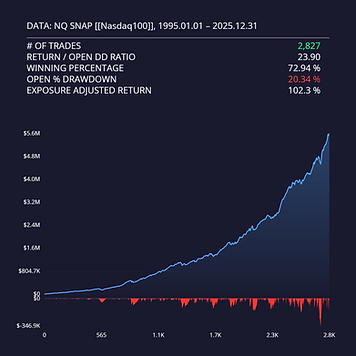
Nasdaq 100 – in the study, the strategy generated 2998 transactions, with a maximum of 40 open positions simultaneously. Such a large number of trades indicates that the system's logic adapts well to the more dynamic, technological segment of the market. But in this test, the results are weaker because we sample up to 40% of the index members.


And here is the performance of the strategy on the 100 most popular ETFs:

Coherent operation across three different universes (S&P 500, Nasdaq 100, Russell 1000, and other ETFs) is a significant argument for the strategy's resilience. The strategy uses stable parameter values, further ensuring robustness.
Recommended Instruments
Based on the conducted tests, the recommended application of the strategy includes:
Main instrument: S&P 500 – the primary environment on which the strategy was designed and optimized.
Additional instruments: Russell 1000, Nasdaq 100, where the system also demonstrated consistent performance.
The strategy can be used both in portfolios focused on the broad U.S. market and in more specialized exposure segments.
Correlation
Checking correlation helps avoid duplicating risk in the portfolio and better combines systems with different profiles. You can find more about correlation here.
Strengths of the Strategy
The engine of the strategy is Trend and Momentum, the best-researched and confirmed phenomena in financial markets.
Significantly higher CAGR than the benchmark with lower maximum drawdown. It is worth noting that the strategy has achieved above-average results in recent years, suggesting the adequacy of its rules for today's market dynamics.
No restrictions related to PDT and low sensitivity to the transaction costs.
Confirmed resilience across various stock indices (S&P 500, Nasdaq 100, Russell 1000) and ETFs, which reduces the risk of overfitting to a single universe.
Weaknesses of the Strategy
Need to accept larger, trend-following price movements – using a high profit target means that positions are often held for a long time, which may not be psychologically suitable for every investor.
Summary
Quantum Trend Strategy is a long-term, trend-following stock strategy that integrates the selection of strong assets with comprehensive market filtering and consistent risk management. Over a 30-year study, this strategy produced significantly higher returns and a higher compound annual growth rate (CAGR) than the SPY benchmark, while also experiencing a drawdown, typical of trend-following strategies. Results from additional markets confirm its robustness, and its mechanics, opposite to mean reversion strategies, set it apart and enable practical implementation in a portfolio.
What you get in the package for this strategy:
An eBook describing detailed rules and results of the strategy.
The SQX file is ready to use on the Algocloud and StrategyQuant platforms.
Pseudocode that describes all the rules in an easy-to-understand way.
Disclaimer
The results obtained from historical data do not guarantee future outcomes. The effectiveness of a strategy can change over time. Backtesting is a tool that allows for the analysis and evaluation of an investment strategy based on historical data. Various factors, such as market changes or economic conditions, can influence the effectiveness of a strategy over time.
Investing always involves risk. This material is not investment advice. We share our experience and algorithms for educational purposes. We make efforts to ensure that our algorithms are error-free, but neither we nor the tools we use guarantee the absence of technical issues. Any decisions to use a particular strategy are made at your own risk and should be preceded by careful understanding and verification. You should always carefully consider your investment goals and risk tolerance before making investment decisions.
BEST STRATEGIES


Week Explorer Strategy
For last 40 years, the best day of the week on the US stock market has been Tuesday. The next day with the highest return is Wednesday. We present a strategy that skillfully exploits this market behavior by opening positions only on Mondays and cashing in profits in almost 70% of cases over the following days.


●
KO Christmas Rally Strategy
The seasonal holiday pattern on Coca-Cola is one fantastic example of how seasons affect stocks. The pattern has a logical justification, which is the association of the brand with holidays built over decades. This consequently influenced consumer and investor behavior before this period.

