

Victa Strategy is a focused equity approach that leverages price and volume price action to capitalize on significant corrections while minimizing drawdowns. This strategy supports stable, long-term portfolio growth.

Inspiration
The Victa Strategy was designed as a unique system for selecting U.S. stocks by precisely identifying moments of strong overselling within a dominant upward trend. The inspiration for its creation came from the observation that even in strong trends, short-term, dynamic corrections can provide attractive entry points for systematic investors—provided the asset remains in a "healthy" trend phase and does not enter a prolonged decline.
The strategy was developed based on extensive testing using S&P 500 index data from 1995 to 2025. It is intended to be a cornerstone of a broader portfolio of strategies, offering different ingredients and parameters compared to other available reversal strategies.
Key Components
Main components of the strategy:
Oversold Filter Based on Cash Flows – The system identifies short-term episodes of significant overselling using capital flow signals, including price and volume. This enables the opening of new positions when selling pressure reaches extreme levels, while the market continues its upward trend.
Long-Term Trend Filters – Before generating a signal, the strategy evaluates the trend's strength. This helps filter out scenarios where an asset enters a bearish phase, making short-term overselling less attractive for investment.
Limit on Number of Positions and Selection Ranking – The strategy can maintain up to 10 open positions at any given time. When multiple signals occur simultaneously, priority is given to companies ranked by volume-based approaches, favoring the selection of liquid, market-significant instruments.
Fixed, Defined Capital Protection Level – Each position is assigned a protection level against adverse price movements, with a built-in time horizon for the maximum holding period of positions.
Together, these elements form a strategy that combines a specifically designed "buy the dip in a trend" approach with clear selection criteria and precisely defined risk management at both the individual transaction and portfolio levels.
Backtest 1 – Fixed $ Money Management
The first set of results comes from a backtest conducted with a fixed position value (Fixed $ Money Management) on the S&P 500 index with an initial capital of 100,000 USD, over a period of 31 years (1995–31.12.2025).


Key results for the Victa Strategy:
Winrate: 68.97% – nearly 7 out of 10 trades ended in profit.
Number of trades: 6,449 – a substantial statistical sample that confirms the reliability of the results.
Average Win/Loss ratio: 0.74 – a single loss is statistically larger than a single gain, but the high percentage of profitable trades balances this parameter.
Yearly Average % Return: 12.71% – an attractive result over the long term, considering only 39% exposure.
Return/Open Drawdown Ratio: 27.17 – the relationship between cumulative return and maximum open drawdown with a constant position size.
These data indicate that the strategy can deliver stable long-term results even with a simple, fixed-dollar approach to position sizing.


Click the button to see the latest backtest:
Backtest 2 – % Money Management
The second set of results comes from the test on percentage money management (% Money Management) and a comparison with the SPY benchmark (ETF on the S&P 500 index).
Comparison table – strategy vs benchmark:

The table shows that with percentage-based capital management, Victa Strategy achieves higher total profit and higher CAGR with significantly lower maximum open drawdown than the benchmark itself.


Trading Strategy Analysis
Net Profit and CAGR
Over a 30-year horizon, the Victa Strategy, with percentage-based capital management, generated a total profit of $4,469,033, starting with $100,000 in capital. This translates to a compounded annual growth rate (CAGR) of 13.12%.
By comparison, the benchmark SPY returned $2,449,918 over the same period and a CAGR of 11.01%. This means the strategy not only outperformed the benchmark in total returns but also delivered a higher compound annual growth rate.
In practice, this means that an investor using the Victa Strategy could achieve better capital growth than a passive investor holding the index, while keeping capital out of the market for approximately 60% of the time.
Drawdown and Return/Open Drawdown Ratio
One of the key parameters of the strategy is the Maximum Open Drawdown. For the strategy with % Money Management, it amounted to 18.13%, while for the benchmark, it reached as much as 55.19%.
Such a large difference in maximum drawdown shows that the strategy manages risk much more effectively than simply holding the index. Smaller drawdowns are particularly important for investors who want to limit the likelihood of large, hard-to-recover losses on capital.
Additionally, in the backtest with a fixed position value (Backtest 1), the Return/Open Drawdown Ratio reached a value of 27.17, illustrating an outstanding relationship between the total result of the strategy and the maximum open drawdown.
Exposure
The strategy operates with an average market exposure of 38.51%, which means that on average, only slightly more than one-third of the capital is engaged in positions.

With such exposure, the Exposure Adjusted Return is 34.07%. In practice, the low average exposure of the strategy creates room to combine it with other systems in the portfolio, without the need for continuous full market engagement. The strategy significantly improves return parameters with moderate capital utilization.
Winning Percent
In the backtest with Fixed $ Money Management, the strategy achieved a win rate of 68.97% with 6,449 trades. Combined with the large number of trades, this means that the strategy's results are well-documented statistically. Although the average profit-to-loss ratio (0.74) indicates that individual losses can be larger than individual gains, the advantage comes from the very high effectiveness and limiting large drawdowns.
SL & TP
In the Victa Strategy, an approach combining a percentage stop loss and dynamic trade exit is used instead of the classic, rigid take profit:
Each position has a stop loss calculated from the entry price, which protects against the excessive impact of a single unsuccessful trade on the portfolio's results.
Profit realization is based on a short-term indicator—the position is closed when the market enters a phase of local overbought conditions.
Additionally, the strategy closes the trade with Exit after bars if the closing condition has not been met earlier.
This combination means that the strategy does not aim for single "maximum" moves but rather for repeatable, controlled profits within a larger trend structure, with a clearly defined maximum risk per single trade.
Market Regime
The system has been tested in diverse market regimes; filtering mechanisms support signal selection according to the prevailing market background. You can find more about market regimes here.
In practice, this means that the strategy is primarily active during periods with a clearly defined upward trend, and its filters help avoid environments with low-quality trends or heightened structural uncertainty in the market.
Trading Costs
The tests included transaction costs and slippage, using data from the broker Alpaca. You can check our latest research on transaction costs using the broker Alpaca here. With a diversified stock portfolio and strategy, transaction costs can determine your profit or loss, so take the time to thoroughly test and choose a broker.
For the Victa Strategy, considering realistic costs is particularly important due to the large number of transactions over a long test period. The backtest results show that even after accounting for commissions and slippage, the strategy maintains an edge over the benchmark.
Robustness
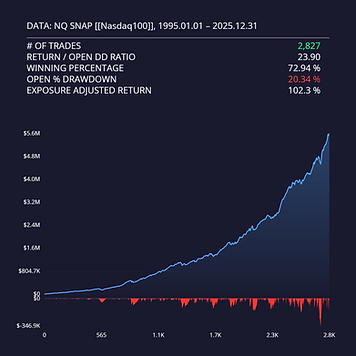
The robustness of the strategy was verified through tests on an additional instrument:
Instrument: Nasdaq 100
Number of tested transactions: 2,392
Maximum number of concurrently open positions: 40

A test on the Nasdaq 100 shows that the strategy's logic is not "fitted" solely to historical S&P 500 data. Mechanisms based on oversold conditions in a trend, as well as trend and movement strength filters, remain useful on a technologically oriented index with a slightly different volatility profile.
Instrument: Russell 1000
Number of tested trades: 18,655
Maximum number of open positions: 40

The strategy includes stable parameter levels, as none in our service have been generated automatically and are not over-optimized.
Tests indicate that the strategy can potentially be used on other stock baskets as well, of course, after conducting separate, detailed backtests.
Recommended Instruments
Primary instrument: S&P 500
Additional instruments: Nasdaq 100 or Russell 1000 – as a portfolio extension.
Pattern Day Trader
Good news. As of June 4, 2026, the existing Pattern Day Trader (PDT) rules are no longer in effect.
In practice, what matters is no longer the mere fact of executing several intraday trades in a short period of time, nor the former $25,000 threshold, but whether the account maintains an adequate margin buffer throughout the day. For investors, this means greater flexibility. Details of the changes are described by:
Finra Regulatory Notice 26-10 | FINRA.org
Alpaca: Understanding FINRA’s New Intraday Margin Rule and the End of PDT
Correlation
Checking correlations helps avoid duplicative risk in a portfolio and better integrate systems with different profiles. You can find more about correlation here.
In practice, the Victa Strategy can serve as an important component of an equity portfolio. By combining it with other strategies—such as systems with lower win rates but higher profit-to-risk ratios, or strategies that operate with different rules and in different market regimes—you can reduce the portfolio's overall volatility while maintaining the expected return.
Strengths of the Strategy
The key strengths of the Victa Strategy are:
Utilization of indicators and parameters that differentiate this strategy's profile from other recommended reversal strategies.
Perfect risk-return profile: high total profit and higher CAGR than the benchmark with significantly lower maximum drawdown.
High transaction effectiveness: a win rate of about 69% with a large number of transactions.
Low market exposure: averaging around 38.5%, allowing for smooth integration of the strategy with other systems in a single portfolio.
Confirmed robustness: good results also on an additional instrument (Nasdaq 100).
Weaknesses of the Strategy
The main potential weaknesses of the strategy are:
Lower average profit to average loss ratio (avg. Win/Loss = 0.74): the advantage mainly stems from a high percentage of profitable trades and controlling drawdowns, rather than very large profits from individual trades.
Lower, yet 100% positive annual results in recent years. This can be compensated for by strategies with different profiles within a well-selected portfolio.
Summary
The Victa Strategy is a system designed to identify specific short-term sell-offs within a long-term upward trend in the US stock market. It integrates comprehensive trend and quality filters with volatility-based entry points and clearly defined exit rules.
Backtesting data from 1995 to 2025 demonstrates that the strategy can yield attractive returns with controlled drawdowns and moderate exposure. These results are validated by a large number of transactions and additional robustness tests on the Nasdaq 100 and Russell 1000. Consequently, the strategy can be a solid component of an algorithmic systems portfolio, particularly when combined with other approaches that have different correlation profiles.
What you receive in the package for this strategy:
An eBook presenting detailed rules and results of the strategy.
An SQX file ready to use on platforms like Algocloud and StrategyQuant.
Pseudocode describing all rules in an easy-to-understand manner.
The Pine Script main indicator code is used in this strategy.
Disclaimer
The results obtained from historical data do not guarantee future outcomes. The effectiveness of a strategy can change over time. Backtesting is a tool that allows for the analysis and evaluation of an investment strategy based on historical data. Various factors, such as market changes or economic conditions, can influence the effectiveness of a strategy over time.
Investing always involves risk. This material is not investment advice. We share our experience and algorithms for educational purposes. We make efforts to ensure that our algorithms are error-free, but neither we nor the tools we use guarantee the absence of technical issues. Any decisions to use a particular strategy are made at your own risk and should be preceded by careful understanding and verification. You should always carefully consider your investment goals and risk tolerance before making investment decisions.
BEST STRATEGIES


Week Explorer Strategy
For last 40 years, the best day of the week on the US stock market has been Tuesday. The next day with the highest return is Wednesday. We present a strategy that skillfully exploits this market behavior by opening positions only on Mondays and cashing in profits in almost 70% of cases over the following days.


●
KO Christmas Rally Strategy
The seasonal holiday pattern on Coca-Cola is one fantastic example of how seasons affect stocks. The pattern has a logical justification, which is the association of the brand with holidays built over decades. This consequently influenced consumer and investor behavior before this period.

