

The strategy effectively identifies overreactions and the subsequent snapbacks, outperforming a buy-and-hold in the long term while maintaining an average exposure of only 8%.

Inspirations
The Bollinger Bounce, with just 8.85% exposure, is highly effective for managing a portfolio containing multiple strategies.
Key Components
Stockpicker selects companies that meet entry criteria.
Buying heavily discounted companies in an upward trend with the expectation of a quick rebound using the Bollinger Bands signal and other components.
Exits based on a strength signal.
Since there are few signals, we use a broader market represented by the Russell 1000 companies.
Backtest 1 – Fixed $ Money Management
In this version, we assess the stability of the parameters and the strategy's performance using a fixed investment amount. Each test consistently involved an investment of $100,000 USD.
Initial investment capital: USD 100,000
Testing period: 31 years
Date range: 1995–2025
Tested instrument: Russell 1000


In the table, we highlighted the moment when the strategy was published.


Click the button to see the latest backtest:
Backtest 2 – % Money Management
In this variant, 100% of the current capital was used in the strategy, so the position value changed in proportion to the account balance. Here are the results:


Trading Strategy Analysis
Net Profit and CAGR
The strategy outperformed SPY in the very long term, in both nominal profit and average annual capital growth rate. This advantage is achieved despite the infrequent use of capital, averaging only 8.85%.
Drawdown and Return/Open Drawdown Ratio
The maximum open drawdown 16.58% is significantly lower than SPY's 55.19%, and the return-to-drawdown ratio is almost 6 times greater than the benchmark 34.67 vs. 5.73, clearly favoring the strategy, while capital risk is controlled and dynamics remain attractive.
Exposure

The average exposure of only 8.85% facilitates integrating the system with other strategies within a portfolio without excessively committing capital.
Winning Percent
SL & TP
The strategy does not use typical Stop Loss and Take Profit, but you can easily add them if you feel more comfortable. The exit is based on market strength conditions and a time exit. You can find more about the approach to stop loss in our article.
Market Regime
The strategy was evaluated in different market regimes. Filtering mechanisms help adjust exposure to conditions. You can learn more about market regimes here.
Trading Costs
The tests accounted for transaction costs and slippage, utilizing data from the broker Alpaca. You can explore our latest research on transaction costs with Alpaca here. With a diversified stock portfolio and strategy, transaction costs can significantly affect your profits or losses. Therefore, it's crucial to test and select a broker thoroughly. For more insights on cost analysis, read our article.
Robustness
The strategy has passed the parameter modification tests. The principle of minimizing the number of parameters was adopted to enhance the strategy's robustness. The criteria for selecting parameters included their significant impact on effectiveness and alignment with the strategy's nature. The system is also effective on other instruments. Here are the test results:
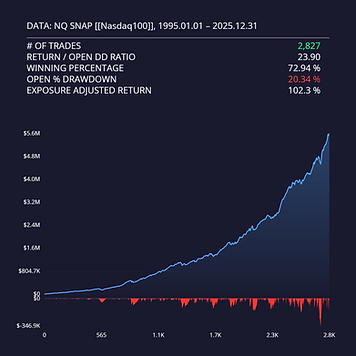
Nasdaq 100
Tested years: 40
Number of trades: 217
S&P500
Tested years: 40
Number of trades: 623

Recommended Instruments
The strategy was initially developed for the Russell 1000.
Pattern Day Trader
Good news. As of June 4, 2026, the existing Pattern Day Trader (PDT) rules are no longer in effect.
In practice, what matters is no longer the mere fact of executing several intraday trades in a short period of time, nor the former $25,000 threshold, but whether the account maintains an adequate margin buffer throughout the day. For investors, this means greater flexibility. Details of the changes are described by:
Finra Regulatory Notice 26-10 | FINRA.org
Alpaca: Understanding FINRA’s New Intraday Margin Rule and the End of PDT
Correlation
Checking correlation helps avoid duplicating risk in a portfolio and better combine systems with different profiles. You can find more about correlation here.
Summary
Strengths of the Strategy
High Win Rate: The strategy boasts a 71.37% win rate, with average profit bigger than average loss, which is very rare for reversal strategies.
Low Drawdown: The open drawdown is only 16.58% compared to 55.19% in the benchmark.
Favorable Risk/Return Profile: The strategy 90%+ remains in cash, seeking genuine opportunities.
High Exposure-Adjusted Return: The strategy achieves an exposure-adjusted return of 145.30%, still significantly outperforming the benchmark of 10.53%.
Weaknesses of the Strategy
Relatively low number of signals.
Performance has varied significantly across different years.
Summary
The Bollinger Bounce is a concise, robust, and highly efficient system for capturing mean reversions within a trend, offering sensible risk control. Remarkably, its results outperform the SPY while requiring minimal capital involvement, just 8.85%, which significantly enhances its utility within a diversified portfolio. The strategy's infrequent trading at extreme deviations complements more frequently trading reversal strategies, such as Volta or Triple B, effectively balancing the reversal side of the portfolio.
What you get in the package for this strategy:
An eBook describing detailed rules and results of the strategy.
The SQX file is ready to use on the Algocloud and StrategyQuant platforms.
Pseudocode that describes all the rules in an easy-to-understand way.
Disclaimer
The results obtained from historical data do not guarantee future outcomes. The effectiveness of a strategy can change over time. Backtesting is a tool that allows for the analysis and evaluation of an investment strategy based on historical data. Various factors, such as market changes or economic conditions, can influence the effectiveness of a strategy over time.
Investing always involves risk. This material is not investment advice. We share our experience and algorithms for educational purposes. We make efforts to ensure that our algorithms are error-free, but neither we nor the tools we use guarantee the absence of technical issues. Any decisions to use a particular strategy are made at your own risk and should be preceded by careful understanding and verification. You should always carefully consider your investment goals and risk tolerance before making investment decisions.
BEST STRATEGIES


Week Explorer Strategy
For last 40 years, the best day of the week on the US stock market has been Tuesday. The next day with the highest return is Wednesday. We present a strategy that skillfully exploits this market behavior by opening positions only on Mondays and cashing in profits in almost 70% of cases over the following days.


●
KO Christmas Rally Strategy
The seasonal holiday pattern on Coca-Cola is one fantastic example of how seasons affect stocks. The pattern has a logical justification, which is the association of the brand with holidays built over decades. This consequently influenced consumer and investor behavior before this period.

