How Much Capital Do You Need for Financial Freedom?

CREATED BY
May 20, 2026
MICHAŁ ZAREMBA
Financial freedom becomes easier to plan when you stop thinking in vague goals and start working with numbers. This guide shows how to estimate your target capital, test different assumptions, and use the Financial Freedom Calculator to build a clearer long-term plan.

Plan your financial freedom with numbers, not guesses
Financial freedom is often described as the moment when work becomes a choice, not a necessity. But to make this idea practical, you need to translate it into numbers.
How much capital do you need?
How much should you save every month?
What annual return do you assume?
How many years may it take?
The Financial Freedom Calculator helps you turn these questions into a simple long-term projection. It allows you to estimate your target capital, test different assumptions, and see how savings, returns, inflation, and withdrawals may affect your path over time.
This is not about predicting the future perfectly. It’s about building a clearer plan.
What is financial freedom?
Financial freedom means that your living costs can be covered by income from your capital, investments, or other passive and semi-passive sources.
In practice, it means that your investment portfolio is large enough to support your lifestyle without relying fully on active work income.
The key number is your target capital.
A simple way to estimate it is:
Target capital = annual expenses ÷ safe withdrawal rate
Example:
If your annual expenses are $60,000 and you assume a 4% withdrawal rate, your estimated target capital is:
$60,000 ÷ 0.04 = $1,500,000
If you prefer a more conservative 3.5% withdrawal rate, the target becomes:
$60,000 ÷ 0.035 = $1,714,285
A small change in assumptions can make a big difference. That’s why testing scenarios matter.
How the calculator works
The calculator simulates the growth of your investment portfolio over time.
You enter your starting assumptions, such as:
current age,
starting capital,
monthly contribution or withdrawal,
expected annual return,
return volatility,
inflation assumptions,
target annual expenses,
safe withdrawal rate.
Based on these inputs, the calculator estimates:
your target capital,
the projected value of your portfolio year by year,
the approximate age or year when financial freedom may be reached,
how sensitive the result is to your assumptions.
One useful feature is return volatility.
Instead of assuming a perfectly smooth return every year, the calculator can add variation to the annual return. For example, if your expected annual return is 8% and volatility is set to 5%, some years may be stronger and some weaker.
This gives a more realistic view than a straight-line projection.
Step-by-step: how to use the calculator
1. Define your financial freedom goal
Start with a practical question:
What does financial freedom mean for you?
For one person, it may mean full retirement.
For another, it may mean working less, choosing only selected projects, or having the option to stop working for several years.
Try to define the lifestyle first. Then estimate the cost of that lifestyle.
2. Estimate your annual expenses
Your target capital depends mainly on your future spending.
Start with your current monthly expenses and adjust them for the lifestyle you want to have later.
Then convert the number into annual expenses.
Example:
$5,000 monthly expenses × 12 = $60,000 annual expenses
This annual number becomes the base for estimating your required capital.
3. Choose your withdrawal rate
The withdrawal rate defines how much of your portfolio you plan to use each year.
A common reference point is the 4% rule, but many investors prefer to test more conservative values, such as 3% or 3.5%, especially when planning for a longer period or higher uncertainty.
Lower withdrawal rate = higher target capital.
Higher withdrawal rate = lower target capital, but less safety margin.
The calculator lets you compare both.
4. Add your current capital and monthly savings
Next, enter how much capital you already have and how much you can add every month.
This part shows the power of consistent saving.
Even small monthly contributions can have a large effect when combined with time and compounding.
You can also test different versions:
current savings level,
higher savings level,
lower savings level,
one-time capital increase,
future withdrawals.
5. Set return and inflation assumptions
Your expected annual return has a strong effect on the result.
But be careful with overly optimistic assumptions. A plan based on very high returns may look attractive on screen but may not be realistic over many years.
A good practice is to test three scenarios:
Base scenario
Your most realistic assumptions.
Conservative scenario
Lower return, higher inflation, lower withdrawal rate.
Optimistic scenario
Higher savings, stronger returns, or lower expenses.
The goal is not to find one perfect number. The goal is to understand how your plan behaves under different conditions.
How to interpret the result
The result should be treated as a planning map, not a final answer.

Pay attention to four things:
1. Time to financial freedom
Does the estimated timeline make sense for you?
If the result is too far away, test what happens when you increase savings, reduce future expenses, or change your withdrawal rate.
2. Sensitivity to return assumptions
If a small change in annual return completely changes the result, your plan may be too dependent on market performance.
That’s a signal to test more conservative assumptions.
3. Inflation impact
Inflation can reduce future purchasing power.
A portfolio value that looks large today may support a different lifestyle in 10, 20, or 30 years. That’s why inflation assumptions should be part of the calculation.
4. Safety margin
Markets don’t move in a straight line.
Bad years, lower returns, unexpected expenses, taxes, and life changes can affect the plan. A lower withdrawal rate or a larger target capital can create more room for error.
Common planning mistakes
The calculator can help you think more clearly, but the quality of the result still depends on your assumptions.
The most common mistakes are:
Using returns that are too optimistic
Assuming high annual returns every year can make the plan look better than it really is.
Ignoring inflation
Future expenses may be higher than today’s expenses.
Forgetting taxes and costs
Brokerage fees, taxes, fund costs, spreads, and currency conversion can reduce real results.
Using only one scenario
A single projection gives a narrow view. Multiple scenarios give a better picture.
Treating the result as fixed
Your income, savings, expenses, and portfolio may change. The plan should be updated over time.
How this fits into an investment process
The Financial Freedom Calculator is a planning tool. It helps you estimate the destination.
The next step is building a process that can move you toward that destination.
That process may include:
regular saving,
portfolio diversification,
systematic investment rules,
risk control,
strategy selection,
periodic review of assumptions.
At Algohubb, we focus on systematic trading strategies, portfolio construction, and research-based decision-making. The calculator can be the starting point: it helps you understand the capital goal. Then you can think about which strategies, portfolios, and risk levels may fit that goal.
Final thought
Financial freedom becomes easier to plan when you stop thinking only in vague goals and start working with numbers.
The calculator helps you answer three practical questions:
How much capital may I need?
How long could it take?
Which assumptions matter the most?
Use it as a planning tool. Test different scenarios. Update your assumptions over time.
Disclaimer
Results are simulations based on your assumptions and are for educational planning purposes only.
BEST STRATEGIES
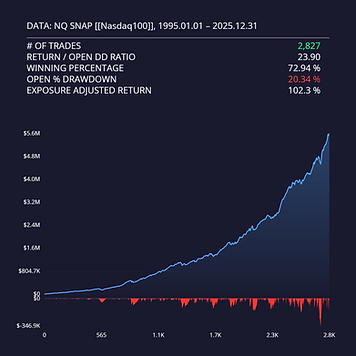


Week Explorer Strategy
For last 40 years, the best day of the week on the US stock market has been Tuesday. The next day with the highest return is Wednesday. We present a strategy that skillfully exploits this market behavior by opening positions only on Mondays and cashing in profits in almost 70% of cases over the following days.


●
KO Christmas Rally Strategy
The seasonal holiday pattern on Coca-Cola is one fantastic example of how seasons affect stocks. The pattern has a logical justification, which is the association of the brand with holidays built over decades. This consequently influenced consumer and investor behavior before this period.

